
Buick Encore: Driving Information / Winter Driving
Driving on Snow or Ice
Snow or ice between the tires and the road creates less traction or grip, so drive carefully. Wet ice can occur at about 0 °C (32 °F) when freezing rain begins to fall. Avoid driving on wet ice or in freezing rain until roads can be treated.
For Slippery Road Driving:
- Accelerate gently. Accelerating too quickly causes the wheels to spin and makes the surface under the tires slick.
- Turn on Traction Control. See Traction Control/Electronic Stability Control.
- The Antilock Brake System (ABS) improves vehicle stability during hard stops, but the brakes should be applied sooner than when on dry pavement. See Antilock Brake System (ABS).
- Allow greater following distance and watch for slippery spots. Icy patches can occur on otherwise clear roads in shaded areas. The surface of a curve or an overpass can remain icy when the surrounding roads are clear. Avoid sudden steering maneuvers and braking while on ice.
- Turn off cruise control.
Blizzard Conditions
Stop the vehicle in a safe place and signal for help. Stay with the vehicle unless there is help nearby. If possible, use Roadside Assistance. See Roadside Assistance Program. To get help and keep everyone in the vehicle safe:
- Turn on the hazard warning flashers.
- Tie a red cloth to an outside mirror.
Warning
Snow can trap engine exhaust under the vehicle. This may cause exhaust gases to get inside. Engine exhaust contains carbon monoxide (CO), which cannot be seen or smelled. It can cause unconsciousness and even death.
If the vehicle is stuck in snow:
- Clear snow from the base of the vehicle, especially any blocking the exhaust pipe.
- Open a window about 5 cm (2 in) on the vehicle side that is away from the wind, to bring in fresh air.
- Fully open the air outlets on or under the instrument panel.
- Adjust the climate control system to circulate the air inside the vehicle and set the fan speed to the highest setting. See “Climate Control Systems.”
For more information about CO, see Engine Exhaust.
To save fuel, run the engine for short periods to warm the vehicle and then shut the engine off and partially close the window. Moving about to keep warm also helps.
If it takes time for help to arrive, when running the engine, push the accelerator pedal slightly so the engine runs faster than the idle speed. This keeps the battery charged to restart the vehicle and to signal for help with the headlamps. Do this as little as possible, to save fuel.
 Hill and Mountain Roads
Driving on steep hills or through mountains
is different than driving on flat or rolling
terrain. Tips include:
Keep the vehicle serviced and in good
shape...
 If the Vehicle Is Stuck
Slowly and cautiously spin the wheels to
free the vehicle when stuck in sand, mud,
ice, or snow.
If stuck too severely for the traction system
to free the vehicle, turn the traction system
off and use the rocking method...
Other information:
Buick Encore 2020-2026 Owner's Manual: Instrument Panel Illumination Control
This feature adjusts the brightness of all illuminated controls. The instrument panel illumination control is next to the exterior lamp control. Push the knob in all the way until it extends out and then turn the knob clockwise or counterclockwise to brighten or dim the lights...
Buick Encore 2020-2026 Owner's Manual: Traction Control System (TCS)/StabiliTrak Light
The StabiliTrak/Electronic Stability Control (ESC) or Traction Control System (TCS) indicator/warning light comes on briefly when the engine is started. If the light does not come on, have the vehicle serviced by your dealer. If the system is working normally, the indicator light turns off...
Categories
- Manuals Home
- Buick Encore Owners Manual
- Buick Encore Service Manual
- Instrument Panel Fuse Block
- Malfunction Indicator Lamp (Check Engine Light)
- Jump Starting
- New on site
- Most important about car
Sun Visors
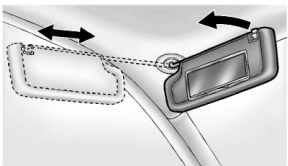
Pull the sun visor down to block glare. If equipped, detach the sun visor from the center mount to pivot to the side window or to extend along the rod.
If equipped, there is a lighted mirror on the sun visor. Lift the cover to open.
